Casa 1
에
Explicação
에' é uma posposição que vem após o substantivo, e informa a direção do objeto ou da pessoa.
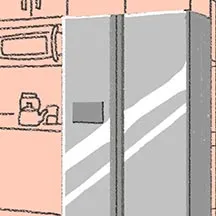
• 주방에 냉장고가 있어요 : Indica a localização da geladeira na cozinha, não em outro lugar.
• 주방에 화분이 없어요.
주방에 냉장고가 있어요.
There’s a refrigerator in the kitchen.
Seemile Korean Book · Casa 1 · p. 41
Form and use
에 is a multi-purpose particle covering location of existence, points in time, direction of movement, and rate/frequency.
| Condition | Form | Example |
|---|---|---|
| ① 존재 장소 | 장소 + 에 있다/없다 | 방에 있어요 |
| ② 시간 | 시간 + 에 | 3시에 · 월요일에 · 내일에(X)→내일 |
| ③ 목적지 | 장소 + 에 가다/오다 | 학교에 가요 |
| ④ 단위 | N + 에 | 하루에 두 번 · 한 개에 천 원 |
방에 컴퓨터가 있어요
There's a computer in the room (① existence)
7시에 학교에 가요
I go to school at 7 (② time + ③ direction)
Exemplos em contexto
주방에 냉장고가 있어요.
Há uma geladeira na cozinha.
| Word | In this sentence | Meaning |
|---|---|---|
| 주방 | 주방에 | cozinha |
| 냉장고 | 냉장고가 | geladeira |
| 있다 | 있어요 | haver |
주방에 화분이 없어요.
Não há um vaso de flores na cozinha.
| Word | In this sentence | Meaning |
|---|---|---|
| 주방 | 주방에 | cozinha |
| 화분 | 화분이 | vaso de flores |
| 없다 | 없어요 | não haver |
식탁에 접시가 없어요.
Não há prato na mesa de jantar.
| Word | In this sentence | Meaning |
|---|---|---|
| 식탁 | 식탁에 | mesa de jantar |
| 접시 | 접시가 | prato |
| 없다 | 없어요 | não haver |
거실에 탁자가 있어요.
Há uma mesa na sala de estar.
| Word | In this sentence | Meaning |
|---|---|---|
| 거실 | 거실에 | sala |
| 탁자 | 탁자가 | mesa |
| 있다 | 있어요 | haver |
탁자에 책이 있어요.
Há um livro na mesa.
| Word | In this sentence | Meaning |
|---|---|---|
| 탁자 | 탁자에 | mesa |
| 책 | 책이 | livro |
| 있다 | 있어요 | haver |
Vocabulário
- 주방
- cozinha
- 냉장고
- geladeira
- 있다
- haver
- 화분
- vaso de flores
- 없다
- não haver
- 식탁
- mesa de jantar
- 접시
- prato
- 거실
- sala
- 탁자
- mesa
- 책
- livro
Prática
- Read one Korean example aloud, then cover it and rebuild the sentence from its meaning.
- Identify the form explained above and compare it with the forms in the word table.
- Change one person, place or object while keeping the grammar and speech level consistent. Check your sentence against the rule.
Vocabulary check
- 핸드폰
- 컴퓨터
- 냉장고
- 텔레비전
Ver resposta
3. 냉장고
Vocabulary check
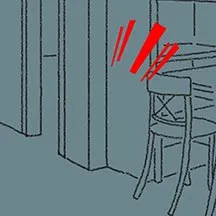
- 있다
- 없다
- 여
- 저기
Ver resposta
2. 없다
Book exercises: p. 44. The online scene quizzes above are separate practice.
Videoaula
여기/저기/거기, 이것/저것/그것, N이 있어요/없어요
YouTube · 18:33Lições relacionadas
- 여기/저기/거기 — ‘여기’, ‘저기’, ‘거기’ são usados para indicar localização. • 여기 : O lugar perto do falante(여기는 내 방이에요.) • 저기 : O lugar longe do falante(저기는 주방이에요.) • 거기 : O lugar longe do falante e perto do ouvinte(거기는 욕실이에요.)
- 이것/저것/그것 — ‘이것’, ‘저것’, ‘그것’ usado para apontar um objeto. • 이것 : Objeto que está perto do falante(이것은 냉장고예요) • 저것 : Objeto que está longe do falante(저것은 소파예요) • 그것 : Objeto que está longe do falante e perto do ouvinte(그것은 책장이에요)
- 있어요 — "'있어요' é usado para expressar a existência de uma pessoa ou objeto no lugar. A forma básica de '있어요' é '있다'. '있어요' é a forma formal e a forma informal é '있어'. E a forma informal pode ser usada como '주전자가 있다', '꽃병이 있어'. • 여기에 주전자가 있어요. • 저기에 의자가 있어요.
- 없어요 — 없어요' é uma expressão usada para dizer quando uma pessoa ou objeto não existe no local. A forma básica é '없다' e '없어' é uma forma informal. Pode ser usado como '컵이 없다' ou '시계가 없어'. • 여기에 컵이 없어요. • 저기에 시계가 없어요.