Home
N에
Explanation
Attach 에 to the location of something that exists. It stays the same regardless of 받침.
주방에 냉장고가 있어요.
There’s a refrigerator in the kitchen.
Seemile Korean Book · Home · p. 41
Form and use
에 is a multi-purpose particle covering location of existence, points in time, direction of movement, and rate/frequency.
| Condition | Form | Example |
|---|---|---|
| ① 존재 장소 | 장소 + 에 있다/없다 | 방에 있어요 |
| ② 시간 | 시간 + 에 | 3시에 · 월요일에 · 내일에(X)→내일 |
| ③ 목적지 | 장소 + 에 가다/오다 | 학교에 가요 |
| ④ 단위 | N + 에 | 하루에 두 번 · 한 개에 천 원 |
방에 컴퓨터가 있어요
There's a computer in the room (① existence)
7시에 학교에 가요
I go to school at 7 (② time + ③ direction)
Examples in context
주방에 냉장고가 있어요.
There is a fridge in the kitchen.
| Word | In this sentence | Meaning |
|---|---|---|
| 주방 | 주방에 | kitchen |
| 냉장고 | 냉장고가 | fridge |
| 있다 | 있어요 | be |
주방에 화분이 없어요.
There isn't a flowerpot in the kitchen.
| Word | In this sentence | Meaning |
|---|---|---|
| 주방 | 주방에 | kitchen |
| 화분 | 화분이 | flowerpot |
| 없다 | 없어요 | be not |
식탁에 접시가 없어요.
There isn't a plate on the dining table.
| Word | In this sentence | Meaning |
|---|---|---|
| 식탁 | 식탁에 | dining table |
| 접시 | 접시가 | plate |
| 없다 | 없어요 | be not |
거실에 탁자가 있어요.
There is a table in the living room.
| Word | In this sentence | Meaning |
|---|---|---|
| 거실 | 거실에 | living room |
| 탁자 | 탁자가 | table |
| 있다 | 있어요 | be |
탁자에 책이 있어요.
There is a book on the table.
| Word | In this sentence | Meaning |
|---|---|---|
| 탁자 | 탁자에 | table |
| 책 | 책이 | book |
| 있다 | 있어요 | be |
Vocabulary
- 주방
- kitchen
- 냉장고
- fridge
- 있다
- be
- 화분
- flowerpot
- 없다
- be not
- 식탁
- dining table
- 접시
- plate
- 거실
- living room
- 탁자
- table
- 책
- book
Practice
- Read one Korean example aloud, then cover it and rebuild the sentence from its meaning.
- Identify the form explained above and compare it with the forms in the word table.
- Change one person, place or object while keeping the grammar and speech level consistent. Check your sentence against the rule.
Vocabulary check
- 핸드폰
- 컴퓨터
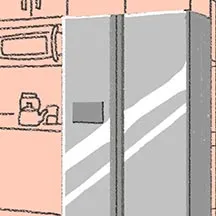
- 냉장고
- 텔레비전
Show answer
3. 냉장고
Vocabulary check
- 있다
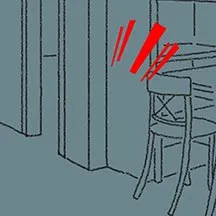
- 없다
- 여
- 저기
Show answer
2. 없다
Book exercises: p. 44. The online scene quizzes above are separate practice.
Video lesson
여기/저기/거기, 이것/저것/그것, N이 있어요/없어요
YouTube · 18:33Related lessons
- 여기/저기/거기 — 여기 is here, 저기 is over there away from both speakers, and 거기 is there near the listener or at a place already mentioned.
- 이것/저것/그것 — Use 이것 for this thing, 저것 for that thing over there, and 그것 for something near the listener or already mentioned.
- N이/가 있어요 — Use N이/가 있어요 for existence or possession. Choose 이 after a consonant and 가 after a vowel.
- N이/가 없어요 — Use N이/가 없어요 for something absent or something you don’t have.